The Invisible Revenue You Are Losing
Here is a scenario every restaurant owner has witnessed but rarely thinks about: a table of six opens the menu. Five of them know what they want within a few minutes. One person — the vegetarian, the Jain guest, or someone with a gluten intolerance — stares at the menu for ten minutes, asks the waiter three questions, and eventually orders a safe, low-value item like a plain dal or a garden salad.
That one hesitant customer just cost you money. Not because they are a difficult guest, but because your menu did not give them the information they needed to order confidently.
Worse, their hesitation slowed down the entire table. The group ordered fewer rounds. They skipped dessert because the ordering process already felt long. And that cautious guest? They probably will not come back — not because your food was bad, but because the experience felt uncertain.
Dietary labels on your restaurant menu fix this problem at the source.
Veg and Non-Veg Marking: The Baseline
In India, FSSAI regulations mandate that packaged food carries the green dot (vegetarian) or brown dot (non-vegetarian) symbol. Yet a surprising number of restaurant menus — especially printed ones — skip this entirely or apply it inconsistently.
This is not just a regulatory checkbox. India has one of the largest vegetarian populations in the world. When a vegetarian customer cannot quickly identify which items are safe to eat, they default to the obvious choices and skip anything ambiguous. That paneer tikka with a cream-based sauce? They might wonder if it contains egg. That biryani? Could be cooked with meat stock.
Clear veg/non-veg marking is the bare minimum. Every single item on your menu should carry this label. No exceptions, no assumptions.
For restaurants outside India, this principle still applies. The specific symbols may differ, but the outcome is the same: when customers can instantly see what fits their diet, they order more items with less friction.
Jain Tagging: The Overlooked Revenue Opportunity
Most restaurants think of Jain dietary needs as a niche concern. This is a significant business mistake.
Jain customers follow strict dietary rules: no root vegetables (onion, garlic, potato, ginger), no mushrooms, and no food prepared after sunset in some traditions. When a Jain guest opens a typical restaurant menu, the vast majority of items are immediately off-limits — not because the dish itself is incompatible, but because there is no way to tell whether it contains onion or garlic.
Here is what most restaurant owners miss about the Jain dining demographic: Jain families and communities tend to dine out in large groups. They celebrate occasions generously. When they find a restaurant that clearly labels Jain-friendly options — or better yet, offers a dedicated Jain section — they become fiercely loyal repeat customers. They bring their extended family. They recommend the restaurant within their community.
A single "Jain" tag next to compatible items can unlock an entire customer segment that actively avoids restaurants where they feel uncertain. The tagging is trivially simple. The revenue impact is not.
If your kitchen can prepare dishes without onion and garlic on request, tag those items as "Jain available" and mention that a Jain preparation can be requested. This small addition signals to Jain diners that your restaurant understands and respects their needs.
Vegan and Gluten-Free: Growing Demographics You Cannot Ignore
The vegan and gluten-free markets are no longer fringe. Plant-based dining is growing at double-digit rates annually across every major market. Gluten-free is not just a lifestyle choice — for people with celiac disease, it is a medical necessity.
These customers have a shared behavior pattern: they research restaurants before visiting. They look for menus online. They scan for labels. If your menu does not clearly indicate vegan or gluten-free options, these customers simply go elsewhere. They do not call ahead to ask. They do not take chances. They pick the restaurant whose menu gives them certainty.
Tagging vegan and gluten-free items is not about catering to a trend. It is about making your existing compatible dishes visible to customers who are actively looking for them. Many restaurants already have vegan items on their menu — they just have not labeled them.
Spice Level Indicators: Fewer Complaints, Fewer Returns
Returned dishes are expensive. The food cost is wasted, the kitchen has to prepare a replacement, the customer's experience is disrupted, and the table's overall order value drops because that guest becomes cautious about ordering anything else.
Spice-related returns are among the most preventable problems in a restaurant. A simple three-level indicator — mild, medium, hot — sets expectations before the order is placed. Customers who love heat will seek out the spiciest options. Customers with low spice tolerance will steer toward milder dishes. Both groups order confidently instead of playing guessing games.
This is especially important for restaurants serving regional or international cuisine where customers may not be familiar with the default spice profile. A first-time visitor to a Chettinad restaurant or a Korean kitchen should not have to learn the hard way that "medium" in that cuisine means something very different from what they expected.
Allergen Labeling: Legal Compliance and Trust
In the EU, allergen labeling on menus is a legal requirement under the Food Information for Consumers Regulation. In the US, the FDA requires disclosure of major allergens. India's FSSAI is moving in the same direction for food service establishments.
Beyond compliance, allergen labels serve a deeper function: they build trust. When a customer with a nut allergy sees that your menu clearly marks dishes containing tree nuts, they feel safe. A safe customer is a relaxed customer, and a relaxed customer orders more.
The 14 major allergens — including peanuts, tree nuts, dairy, eggs, soy, wheat, shellfish, and sesame — cover the vast majority of allergic reactions. Tagging these on your menu is not an enormous undertaking, and it signals a level of professionalism and care that customers notice.
Restaurants that skip allergen labeling are not just risking regulatory penalties. They are telling a significant portion of potential customers that their safety is not a priority.
The Restrictive Eater Bottleneck in Group Dining
This is the dynamic that makes dietary tagging a revenue multiplier, not just a nice-to-have feature.
When a group dines together, the ordering pace is set by the slowest person. If one person in a group of eight cannot find suitable options quickly, the entire table waits. The conversation shifts from "what looks good" to "can you eat this?" The energy around ordering drops. People start settling for safe choices instead of exploring the menu.
This bottleneck effect means that one unclear menu costs you orders from the entire table — not just from the person with dietary restrictions.
When every dish carries clear dietary labels, the person with restrictions can scan the menu just as fast as everyone else. The group orders together. Nobody feels like a burden. The table orders more courses because the process was smooth.
Multiply this across every table with a mixed-diet group — which is most tables — and the revenue impact becomes substantial.
How Digital Menus Make Tagging Practical
On a printed menu, adding dietary tags for every item creates visual clutter. You end up with a legend at the bottom of the page and tiny symbols that nobody reads. The constraint of print makes comprehensive tagging impractical.
Digital menus remove this constraint entirely.
On a digital menu, dietary information appears as clean, color-coded badges next to each item: a green badge for vegetarian, a leaf icon for vegan, a "JN" tag for Jain-friendly, a wheat-crossed icon for gluten-free. The badges are visually distinct without being overwhelming.
More importantly, digital menus enable filtering. A vegan customer can tap a single filter and see only vegan items across all categories. A customer with a nut allergy can exclude all dishes containing tree nuts. Guests can even ask an AI concierge in plain language — "show me Jain starters" or "which desserts are gluten-free" — and get an instant, accurate shortlist. This is not possible with a printed menu at any level of design quality.
Digital menus also make it easy to update tags. Discovered that your dal makhani recipe actually contains cream and is not vegan? Update the tag instantly. No reprinting, no stickers over the old tag, no outdated information sitting on tables.
The ROI of Dietary Tagging
The return on investment for dietary labels is disproportionately high relative to the effort involved.
More items ordered per table. When every guest can identify suitable dishes quickly, tables order more appetizers, sides, and desserts. The hesitation tax disappears.
Fewer returns and remakes. Spice level indicators and allergen tags mean customers get what they expected. Kitchen waste drops. Staff time spent handling complaints is redirected to service.
Repeat customers from underserved demographics. Jain families, vegan groups, and allergy-conscious diners actively seek out restaurants that cater to them. They become regulars and refer others — and a quick WhatsApp win-back or birthday offer keeps them coming back after that first great visit.
Higher online ratings. Guests with dietary restrictions who have a smooth experience leave positive reviews. Guests who felt uncertain or unsafe leave negative ones. The tagging directly influences your rating on Google, Zomato, and Swiggy.
Faster table turnover. When the ordering process is smooth for everyone at the table, the overall dining time decreases slightly. Over a busy evening, this adds up to additional covers.
Action Steps: Start This Week
You do not need to overhaul your menu to start seeing results. Here is a practical sequence:
1. Audit your current menu. Go through every item and classify it: vegetarian, non-vegetarian, vegan, Jain-friendly, contains common allergens. Your chef should be able to do this in an afternoon.
2. Start with veg/non-veg. If you are not already marking every item, do this first. It is the highest-impact, lowest-effort change.
3. Add Jain tags. Identify items that are already Jain-compatible or can be prepared Jain on request. Tag them explicitly.
4. Add spice levels. A simple mild/medium/hot classification takes minutes per item and immediately reduces spice-related complaints.
5. Add allergen information. Start with the top eight allergens. Your ingredient lists should make this straightforward.
6. Move to a digital menu. If you are still on printed menus, the tagging exercise above will be ten times more effective on a digital platform where customers can filter and search by dietary preference. You can set up a free digital menu in minutes and add the tags as you go.
The restaurants that get dietary tagging right do not just avoid losing customers. They actively attract the customers that every other restaurant in their area is passively turning away — and dietary clarity is just one lever; our menu optimization guide covers the rest.
Related Articles
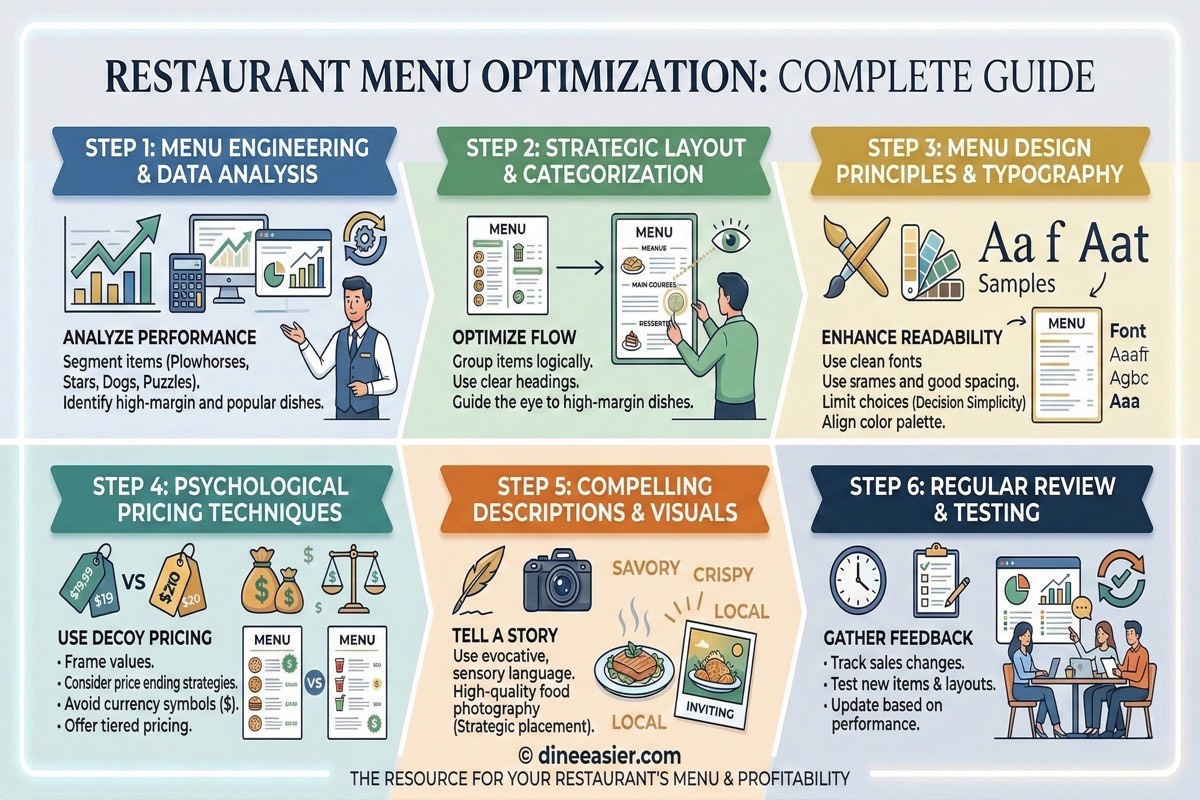
Restaurant Menu Optimization: The Complete Guide to Selling More With Your Menu
Your menu is your most powerful sales tool. Learn menu psychology, pricing strategies, dietary tagging, and digital menu tactics that increase average order value by 20-40%.
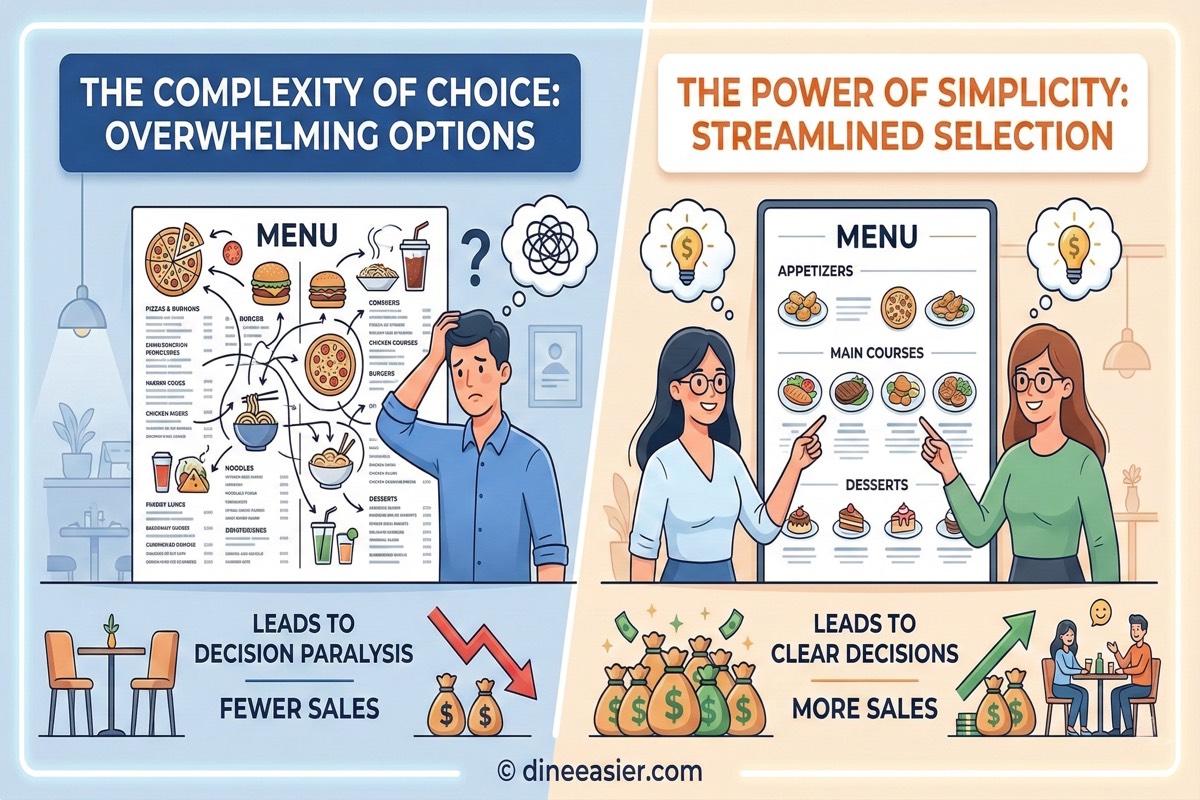
Why Too Many Items on Your Restaurant Menu Hurt Sales
Research shows oversized menus overwhelm diners, increase waste, and slow your kitchen. Learn the ideal menu size and how to trim yours for higher profits.

All-in-One Restaurant Management Software: Stop Paying for 5 Separate Tools (2026)
Most restaurants run on 5+ disconnected apps for ordering, scheduling, SOPs, and bookings. Here is why an all-in-one platform saves money, time, and sanity.