There's a moment in every hotel stay that quietly decides whether the guest will order room service that night.
It's the moment they pick up the phone.
They've been traveling all day. It's 10:47 PM. They're hungry but exhausted. They can see the room-service card on the nightstand. They flip through it. The photos are printed on laminated paper from 2018. Half the prices are outdated. The descriptions are generic.
They lift the receiver. It rings. No one picks up for 40 seconds. Finally someone answers, harried. The guest — who doesn't speak fluent English — tries to communicate that he's vegetarian, his wife has a nut allergy, and their son wants plain rice. Three exchanges later, he's no longer sure his order is correct. He hangs up. The order arrives 55 minutes later with the wrong dish.
Next night, he orders Zomato to his room instead.
This is not a one-off story. This is the median experience of hotel room service in 2026. And it's why most hotels see only 5–10% of guests actually using room service, despite guests consistently rating F&B as a top reason they stay at full-service properties.
The Real Failure Point Is the Phone
Every other step in the room-service process is fine. The kitchen can cook. The menu is decent. The runner can deliver. The problem is the interface between the guest and the kitchen.
That interface has been a phone call for 80 years. It has the following failure modes:
- The call doesn't connect fast enough. F&B picks up after 3-5 rings. Enough to kill the impulse.
- The guest doesn't speak the staff's language fluently. International guests especially. Halting phone conversations cause miscommunication.
- The menu is hidden. Guests can't "browse" verbally. They order whatever they saw first on the printed card.
- Modifications get lost. "No capsicum" becomes "no cheese" three seconds later in verbal translation.
- Staff can't upsell naturally. Trying to suggest add-ons over the phone feels pushy. So staff don't bother.
- Late-night coverage breaks down. After 10 PM, one staff member covers multiple duties. Response times get worse exactly when guest demand for quick food is highest.
Every one of these failure modes is an ordering-interface problem. Replace the interface and all of them disappear at once.
What "AI Captain" Means for a Hotel
A captain, in the Indian hospitality tradition, is the senior service staff who takes orders, reads the guest, and coordinates between the floor and the kitchen. At a hotel, the equivalent role is split between the room-service attendant (on the phone) and the runner (delivering).
An AI Captain collapses those functions into software that lives at the table, on the nightstand, at the poolside lounger — wherever the guest is.
On a nightstand, it looks like a small branded QR card next to the kettle. The guest scans. A mobile-friendly menu loads. The AI Captain greets them with the hotel's name, asks how it can help, and responds in the guest's preferred language.
The guest asks for something vegetarian. The menu filters. They ask for something under 400 calories. It filters again. They ask if the biryani is spicy. The AI Captain answers with the actual spice level of that dish. They place the order — with modifications, notes, and allergies attached.
The kitchen gets the order instantly, with the room number, guest name (if logged in), and all modifications printed correctly on the KOT. The delivery runner gets a notification. Fifteen minutes later there's a knock at the door.
Zero phone calls. Zero language barriers. Zero miscommunication.
The Multi-Outlet Advantage
Most hotel F&B has more than one outlet. Main restaurant. Coffee shop. Poolside grill. Spa cafe. Banquet hall during events. Room service.
In the phone-based model, each outlet has its own extension, its own menu card, its own staff workflow. Guests rarely know what's available from where.
An AI Captain can present all of them through a single scan, with intelligent routing:
- Guest is in the room at 11 PM → shows the 24-hour menu, routes to the overnight kitchen
- Guest is at the pool at 3 PM → shows the poolside grill menu, routes to pool service
- Guest is at the lawn for an event → shows the banquet menu, routes to the event chef
- Guest is at the spa → shows the healthy cafe menu, routes to the spa kitchen
One platform. One scan experience. Full operational separation behind the scenes. Nothing for the guest to remember.
For resorts with large layouts — poolside dining on one side of the property, beach huts on another, fine-dining restaurant in the main block — this is not a nice-to-have. It's the difference between a guest ordering and a guest giving up.
24/7 Without Staffing 24/7
The ordering interface is now 24/7 — the kitchen is not.
An AI Captain knows which outlets are open at which times. The menu it shows changes automatically:
- Breakfast (6:00–11:00 AM): breakfast menu, main restaurant kitchen
- All-day dining (11:00 AM–10:30 PM): full menu, all outlets active
- Late-night (10:30 PM–6:00 AM): limited menu, overnight kitchen only, with clear expectations ("30-minute delivery")
Guests are never surprised. Staff are never flooded with orders they can't fulfill. The interface enforces the operating reality.
What the Data Actually Looks Like
Hotels that replace phone-based room service with an AI Captain interface see patterns that are remarkably consistent:
| Metric | Phone-based | AI Captain |
|---|---|---|
| % of guests who use room service per stay | 8–12% | 28–40% |
| Average order value | ₹450 | ₹620 |
| Order accuracy | 78–85% | 98%+ |
| Average time from guest intent to order placed | 4.5 min | 40 sec |
| Complaints about F&B service per 100 stays | 11 | 2 |
| Repeat orders per guest per stay | 1.3 | 2.1 |
The "average order value" line is worth lingering on. The single biggest driver is browsing. Guests who can see photos, descriptions, and related items order more than guests who are trying to remember what's on a menu card.
The "repeat orders per stay" line is the other big one. Once guests know ordering takes 40 seconds, they order more often. A guest who ordered once per stay now orders breakfast and a late-night snack and poolside snacks the next day — from the same hotel kitchen, instead of giving up after one friction-filled experience. And the relationship doesn't end at checkout — order confirmations, invoices, and later win-back offers can reach guests over WhatsApp automatically, bringing past guests back on their next trip.
The Language Problem, Finally Solved
If your hotel takes international guests, language has been an unsolvable problem at the room-service interface.
You can't hire a staff member fluent in every language your guests speak. You can't expect every guest to be fluent in the staff's language. Translation cards on the room-service menu help a little, but they can't handle modifications or questions.
An AI Captain handles the full conversation in any language. A guest from Osaka types in Japanese. The AI Captain responds in Japanese. It takes the order in Japanese. It translates the modifications into accurate English for the kitchen. The kitchen cooks exactly what was ordered.
For destination resorts — Goa, Jaipur, Phuket, Bali, Dubai — this alone is worth the implementation. It's the difference between a 4-star Tripadvisor review and a 2-star one.
Where This Matters Most for Hotel Operators
Not every property sees the same impact. The uplift is largest for:
- Resorts with multiple outlets and dispersed zones. Beach, pool, lawn, spa, main restaurant — all unified through one guest-facing interface.
- Business hotels with international guests. Language and speed both matter.
- Properties with late-night demand but limited late-night staffing. AI Captain handles the interface, kitchen capacity stays lean.
- Multi-property hotel groups. Standardize the ordering experience across every property without standardizing the menu. Corporate gets visibility, individual GMs keep control.
The uplift is smaller — but still real — for small boutique properties where every guest is already known by name. Even there, language and 24/7 availability move the needle.
What It Doesn't Replace
Clarity on what AI Captain doesn't do:
- It doesn't replace the runner who delivers the food. Physical delivery is still human.
- It doesn't replace the concierge who handles travel questions and local recommendations. (Though some AI Captain implementations include a concierge mode.)
- It doesn't replace the chef. Quality still depends on the kitchen.
- It doesn't replace the human who recovers a service failure. When something goes wrong, your staff handles it — better, because they're not stuck on the phone for routine orders.
It replaces the transactional interface. Everything that is hospitality, rather than data entry, stays in human hands.
Implementation for Hotels
The setup is standardized enough that most properties go live in under a week:
- Upload menus (per outlet) — or scan your existing printed menus and let the AI digitize them
- Generate QR codes — one per room, plus codes for each pool lounger, lawn table, spa zone, etc.
- Print and place — branded tent cards on nightstands, small codes laminated at poolside tables, larger codes at the spa
- Kitchen setup — KDS or printer per outlet. Modifiers, allergens, and timing notes come through automatically
- Staff briefing — front-of-house and F&B staff stop being order-takers, start being recovery and hospitality specialists
- Soft launch — run both the phone option and the AI Captain in parallel for 2 weeks, watch the shift
- Full switch — move the phone number to a secondary option on the in-room card
The Competitive Shift That's Already Happening
Hotel guests in 2026 already expect app-level ordering experiences, because that's what every food-delivery platform has trained them to expect. A resort that still relies on a laminated menu and a call to reception is not competing on a level field with a resort that offers one-tap ordering in the guest's language.
The guests voting with their wallets are the ones you most want to retain: frequent travelers, high-spend F&B customers, younger couples, and international families. These are the exact segments that find phone-based room service the most frustrating.
The first few properties in a destination market that move to AI Captain will capture disproportionate share of this segment. By the time your competitors catch up, you'll have two years of guest data, loyalty, and operational experience they don't have.
Start With One Outlet
If the full rollout feels like a lot, start with just one outlet. Most hotels pilot with room service first — it's the outlet with the worst existing experience, so the uplift is visible in weeks, not months.
Once the numbers are real, expanding to the poolside and the restaurant is a one-day exercise.
Want to see AI Captain running on your own hotel's menu? We'll set up a live demo in 15 minutes — book a slot here.
Related Articles
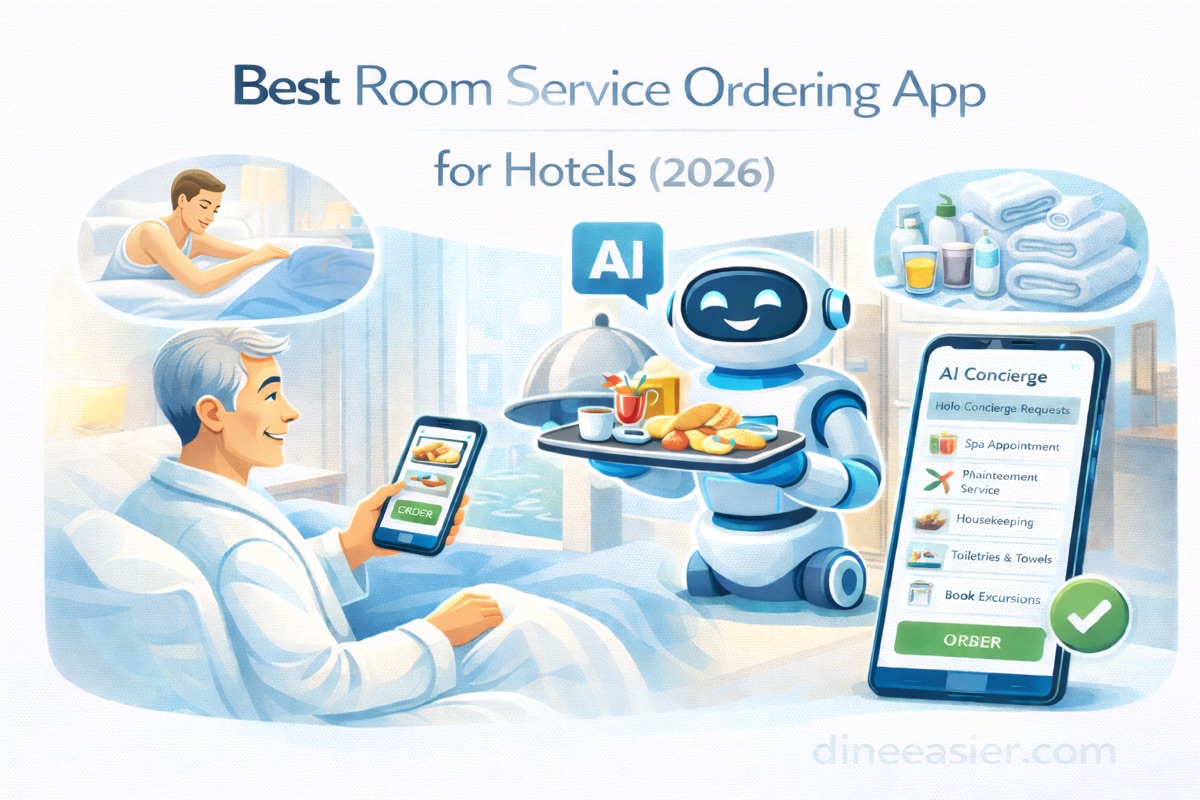
Best Room Service Ordering App for Hotels (2026)
Phone-based room service is broken. Discover the best AI-powered room service ordering apps that let guests order from bed, in any language, 24/7.
AI Captain for Bali: The Ordering Problem Every Water Villa and Beach Club Has
Bali resorts lose enormous F&B revenue to GoFood and GrabFood — not because the food is worse, but because ordering from a water villa deck or pool lounger is broken. Here is the fix.

AI Captain for Dubai: The Ordering Upgrade Luxury Hotels Have Been Waiting For
Dubai's luxury hospitality sets global benchmarks — except at the ordering interface, which still runs on 1990s phone calls. Here's what happens when Burj-tier hotels replace the phone with AI Captain.