Most Restaurants Are Leaving Money on the Table
Working out where you stand today? Our free food cost calculator compares what your recipes say you should have used against what you actually bought — the gap is usually where the margin went.
Here is an uncomfortable truth: the majority of restaurant owners price their menu based on gut feel, competitor guessing, or a quick markup they picked years ago and never revisited. The result is a menu that either undercharges (killing margins) or overcharges (killing volume), with no strategy in between.
Menu pricing is not a one-time decision. It is the single highest-leverage activity you can do for your bottom line. A 1% improvement in pricing has a larger impact on profit than a 1% improvement in volume or a 1% reduction in costs. McKinsey research confirms this across industries, and restaurants are no exception.
This guide covers the methods, psychology, and tactics that separate restaurants with healthy margins from those wondering where the money went. Pricing is one pillar of the broader menu optimization playbook.
The Food Cost Percentage Method
This is the foundation. Every restaurant menu pricing strategy starts here.
Food cost percentage is the ratio of raw ingredient cost to the menu selling price:
Food Cost % = (Cost of Ingredients / Menu Price) x 100
The industry benchmark is 28-35% for most restaurants. Fine dining can go lower (25-30%) because labor and ambiance justify higher prices. Casual dining and QSR typically aim for 30-35%.
How to calculate your menu price
If a dish costs you 120 to make in raw ingredients, and you want a 30% food cost:
Menu Price = Ingredient Cost / Target Food Cost % = 120 / 0.30 = 400
That gives you a starting point. Not a final answer -- just a floor. You then adjust based on the strategies below.
Where most restaurants go wrong
They calculate food cost once and forget about it. Ingredient prices fluctuate seasonally, supplier costs change, and portion creep happens. Review your food costs quarterly at minimum. If a dish has drifted to 40% food cost, you either raise the price, reduce the portion, or swap an ingredient.
Pro tip: Track your blended food cost across the entire menu, not just per item. Some items can run at 40% if they drive volume, as long as your high-margin items (beverages, desserts) bring the average down.
Competition-Based Pricing
You do not operate in a vacuum. Customers compare your prices to similar restaurants in your area, whether consciously or not.
The approach:
- Identify 3-5 direct competitors (same cuisine, same neighborhood, same price tier).
- Collect their prices for comparable items.
- Position yourself intentionally: match, undercut, or premium.
The mistake is blindly matching competitor prices. If your ingredients are better, your ambiance is better, or your portion is bigger, you should charge more. If you are trying to win on volume, price slightly below. But have a reason.
Key insight: Customers do not compare every item. They anchor on 2-3 familiar items (butter chicken, margherita pizza, a basic cocktail) and use those to form a price perception of your entire restaurant. Price those benchmark items competitively, and you have more freedom to price the rest of your menu for margin.
Pricing Psychology That Actually Works
This is where data beats intuition. Decades of research show that how you present prices matters as much as the prices themselves.
Drop the Currency Symbol
A well-known Cornell University study found that guests who saw prices without currency symbols (just "450" instead of "$450" or "Rs. 450") spent 8-12% more. The currency symbol activates the "pain of paying" in the brain. Without it, the number feels more abstract.
This works especially well on digital menus where you control the formatting precisely. On printed menus, it is a design choice, but on a digital menu you can implement it in minutes.
Charm Pricing vs. Round Pricing
Prices ending in 9 (299, 499) signal value. They work well for mid-range items, lunch specials, and anything where the customer is price-conscious.
Prices ending in 0 (300, 500) signal quality and confidence. They work for premium items, craft cocktails, and specialty dishes where you want the customer thinking about the experience, not the deal.
The worst option? Prices ending in 5 (295, 395). They sit in an awkward middle ground that signals neither value nor quality. Avoid them.
Do Not Column-Align Your Prices
This is one of the most common -- and most damaging -- menu design mistakes. When prices are neatly right-aligned in a column, customers can scan straight down the price column without reading a single description. Your menu becomes a price list, and they pick the cheapest option.
The fix: Place the price immediately after the item description, in the same font size, separated by a few dots or a dash. This forces the customer to read through the description (which sells the dish) before they encounter the price.
On digital menus, this happens more naturally because items are displayed as cards or rows with the price integrated into the layout. But even on digital menus, avoid a separate, scannable price column.
The Anchoring Effect
Anchoring is one of the most powerful pricing tools, and most restaurants use it by accident rather than by design.
How it works: When a customer sees a 1,200 item at the top of a category, the 550 item below it feels like a reasonable choice. Without the anchor, that same 550 item might feel expensive.
You do not need the anchor item to be a top seller. It just needs to exist. Some restaurants add a premium "signature" version of a popular dish -- a truffle-topped pizza, a wagyu burger -- specifically to anchor the rest of the category.
Restaurants that deliberately add anchor items report 8-15% increases in average order value. The anchor shifts the customer's internal reference point upward, making mid-range items (your highest-margin items) feel like the smart choice.
How to implement: Place one premium item at the top of each major category, priced 40-60% above your category average. Give it a compelling description. Even if it sells rarely, it is doing its job.
Bundle and Combo Pricing
Bundles work for two reasons: they increase average order value, and they give the customer a feeling of getting a deal.
The psychology: A meal combo priced at 499 (starter + main + drink) feels like a bargain when the items individually total 620. The customer saves 121 and feels smart. You sell three items instead of one or two. Both sides win.
Effective bundling strategies
- Pair high-margin items with popular ones. If your dal makhani has a 25% food cost and your naan has a 15% food cost, bundle them. The blended cost is great for you, and the customer sees convenience.
- Create tiered combos. Offer a "regular" combo and a "premium" combo. The regular combo anchors the price; the premium combo is where your margin lives.
- Limit choices within bundles. "Pick 1 starter + 1 main + 1 drink" works. "Pick any 3 items" creates decision paralysis and operational complexity.
On digital menus, bundles can be surfaced contextually -- when a customer adds a main course, an AI concierge can suggest the combo upgrade. This alone can increase combo adoption by 30-40% compared to a static printed menu.
Dynamic Pricing for Digital Menus
This is where digital menus unlock something printed menus never could: the ability to change prices based on context.
Time-of-day pricing
Lunch crowds are price-sensitive. Dinner crowds less so. With a digital menu, you can offer a lunch price and a dinner price for the same dish without printing two menus. The customer sees one price -- the right price for that moment.
Seasonal pricing
When tomato prices spike in the off-season, your tomato-heavy dishes cost more to make. With a digital menu, you can adjust those prices for the season and revert when costs normalize. No reprinting, no stickers over old prices.
Demand-based pricing
If a dish consistently sells out by 8pm, you might be underpricing it. If another dish never moves, it might be overpriced. Digital menus let you experiment with pricing and measure results in real time, something that takes months with printed menus.
Important caveat: Dynamic pricing must be transparent. Customers should never feel tricked. "Lunch special pricing" is acceptable. Silently charging more during a busy hour is not. Frame changes as offers or specials, not as surcharges. And a price is only half the story — the same platform can push those offers and coupons to lapsed guests through automated win-back campaigns and targeted guest segments, turning a pricing lever into a retention one.
Common Menu Pricing Mistakes
These are the errors that quietly drain margin, month after month.
Pricing everything with the same markup. A flat 3x markup across your entire menu means your low-cost items are underpriced and your high-cost items are overpriced relative to what customers will pay. Use food cost percentage as a floor, then adjust per category.
Ignoring item mix. If 60% of your orders are your lowest-margin dish, your blended food cost is terrible regardless of what your spreadsheet says. Track what actually sells, not just what is on the menu.
Raising prices without adding value. If you increase prices by 10%, give customers something: a slightly larger portion, a better garnish, a description that emphasizes quality. Price increases without perceived value increases drive customers to competitors.
Not pricing for profit, pricing for revenue. A 500 dish with 40% food cost makes you 300 in gross profit. A 350 dish with 22% food cost makes you 273. The cheaper dish is almost as profitable and likely sells in higher volume. Revenue is vanity; profit is sanity.
Neglecting beverage pricing. Beverages typically carry 15-22% food cost, making them your highest-margin category. Yet most restaurants treat the drinks menu as an afterthought. Highlight beverages, suggest pairings, and make them easy to add. They are your margin engine.
Putting It All Together
A strong restaurant menu pricing strategy is not about any single tactic. It is the combination:
- Start with food cost percentage as your pricing floor (28-35%).
- Adjust for competition on benchmark items customers compare.
- Apply psychology -- drop currency symbols, use charm/round pricing intentionally, break price columns.
- Anchor each category with a premium item.
- Bundle strategically to increase order value.
- Use digital menus to enable dynamic, context-aware pricing.
- Review quarterly -- costs change, and your prices should keep pace.
The restaurants that treat pricing as an ongoing discipline rather than a one-time decision are the ones that consistently maintain healthy margins, even when ingredient costs rise and competition intensifies.
Your menu is your most powerful profit tool. Price it like one.
Related Articles
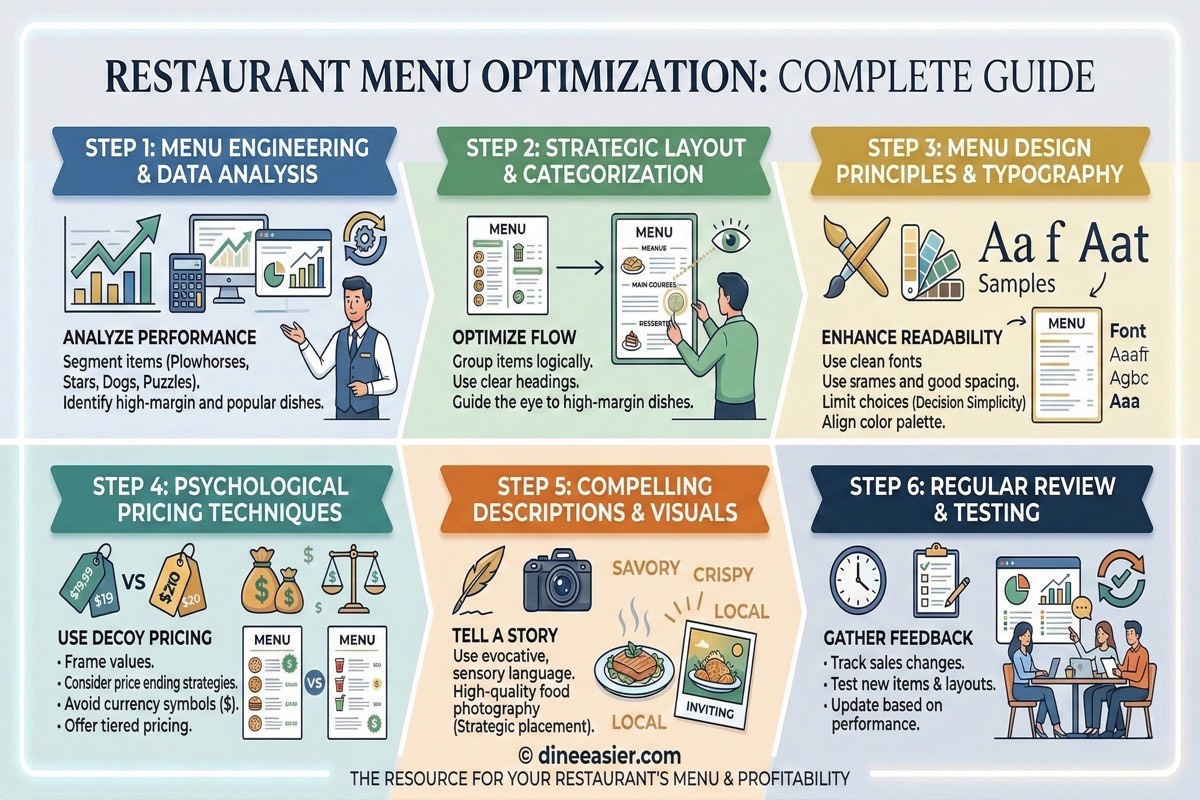
Restaurant Menu Optimization: The Complete Guide to Selling More With Your Menu
Your menu is your most powerful sales tool. Learn menu psychology, pricing strategies, dietary tagging, and digital menu tactics that increase average order value by 20-40%.
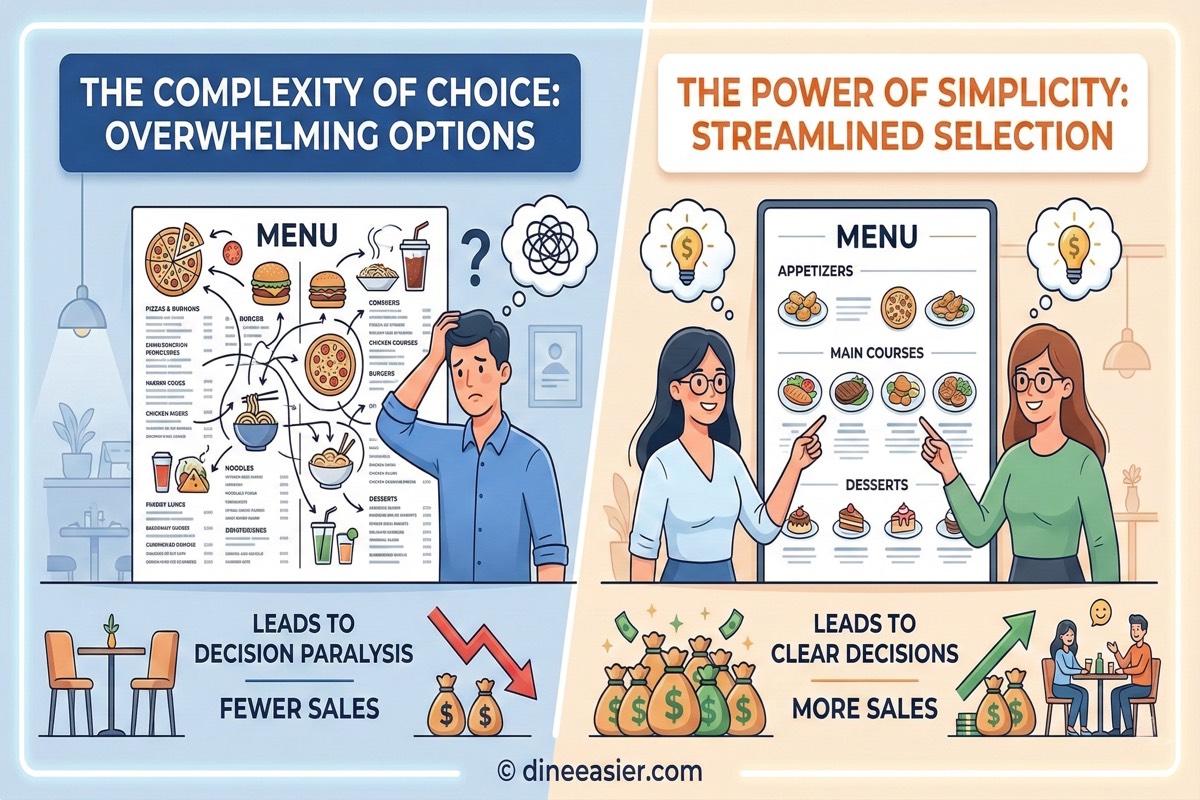
Why Too Many Items on Your Restaurant Menu Hurt Sales
Research shows oversized menus overwhelm diners, increase waste, and slow your kitchen. Learn the ideal menu size and how to trim yours for higher profits.
All-in-One Restaurant Management Software: Stop Paying for 5 Separate Tools (2026)
Most restaurants run on 5+ disconnected apps for ordering, scheduling, SOPs, and bookings. Here is why an all-in-one platform saves money, time, and sanity.