The Revenue Challenge
Running a restaurant has always been a margins game. Food costs, rent, labor, utilities — they all keep rising. Yet raising menu prices aggressively risks losing customers.
The restaurants growing profitably in 2026 aren't just raising prices. They're using technology to sell more to each customer and serve more customers efficiently.
Here are seven strategies that actually work, backed by real data.
1. Visual Menus Increase Order Size
This is the simplest, most proven technology investment: add photos to your menu.
Research consistently shows that menu items with photos sell 30% more than text-only listings. When customers can see a beautifully plated dish, they're more likely to order it — especially appetizers, desserts, and premium items they might skip otherwise.
A digital menu makes this easy. You don't need a professional photographer — even well-lit phone photos significantly outperform no photos.
Expected impact: 15-30% increase in average order value.
2. AI-Powered Upselling
Human servers upsell inconsistently. They forget during rushes. They feel awkward suggesting the more expensive option. They skip dessert suggestions when they're busy.
An AI ordering assistant suggests complementary items naturally and consistently:
- "Would you like to add our house-made naan to go with that curry?"
- "Our mango lassi is the perfect pairing for spicy dishes!"
- "Save 15% with our combo meal — adds a drink and dessert"
It does this for every single customer, every single time.
Expected impact: 10-20% increase in average order value.
3. Reduce Wait Time, Serve More Customers
In a typical dine-in restaurant, the sequence of waiting — for a menu, to order, for the check — adds 15-20 minutes of non-eating time to every visit.
Digital ordering cuts this dramatically:
- No waiting for menus (scan QR, instant access)
- No waiting to order (self-service)
- No waiting for bill (order total visible in cart)
Faster dining cycles mean higher table turnover during peak hours. A restaurant that turns tables 3 times during lunch instead of 2.5 serves 20% more customers.
Expected impact: 15-25% increase in covers during peak hours.
4. Out-of-Stock Management
Nothing frustrates a customer more than ordering something and being told "sorry, we're out." It happens constantly with printed menus because there's no way to update them in real-time.
With a digital menu, you toggle availability with one tap. Customers never see items you can't serve. This:
- Eliminates disappointment
- Reduces kitchen disruptions from order cancellations
- Keeps the ordering flow smooth
Expected impact: 5-10% reduction in order cancellations and refunds.
5. Loyalty and Rewards Programs
Technology makes loyalty programs actually manageable. Without it, you're printing punch cards and tracking nothing. With it, you can:
- Track customer visit frequency and spending automatically
- Offer personalized rewards based on ordering history
- Send targeted promotions (not spam — relevant offers)
- Build a direct communication channel with your regulars
Modern platforms automate all of this — reward points, birthday and win-back offers, and order confirmations go out over WhatsApp automatically, so retention runs without adding another tool.
Loyal customers spend 67% more than new ones. A rewards program isn't a cost — it's an investment in higher-value repeat visits.
Expected impact: 15-25% increase in repeat visit frequency.
6. Data-Driven Menu Engineering
Without data, menu decisions are guesswork. With a digital menu, you know exactly:
- Which items are viewed most vs. ordered most (high views but low orders = pricing or description problem)
- What time of day each item sells best
- Which categories drive the highest spend
- What customers search for but don't find (menu gaps)
Use this data to:
- Promote high-margin items that aren't getting attention
- Remove items nobody orders (reduces kitchen complexity)
- Adjust pricing based on actual demand
- Create combos from frequently co-ordered items
Expected impact: 5-15% improvement in food cost margins.
7. Multiple Revenue Channels
Technology enables revenue streams that weren't practical before:
- Takeaway/pickup ordering through the same digital menu
- Pre-ordering for large groups and events
- Catering menus accessible via QR or link
- Merchandise or packaged goods (house sauces, spice mixes) sold through your menu
Your digital menu is a storefront that works 24/7. A customer who scans your QR code at 11 PM can browse and place a takeaway order for tomorrow's lunch.
Expected impact: 10-20% additional revenue from new channels.
The Compound Effect
Each strategy individually produces a modest lift. Combined, the effect compounds:
| Strategy | Revenue Impact |
|---|---|
| Visual menus | +15-30% order value |
| AI upselling | +10-20% order value |
| Faster turnover | +15-25% peak covers |
| Out-of-stock management | -5-10% cancellations |
| Loyalty programs | +15-25% repeat visits |
| Menu engineering | +5-15% margin improvement |
| Multiple channels | +10-20% new revenue |
A restaurant implementing even 3-4 of these strategies typically sees a 20-40% total revenue increase within 6 months.
Where to Start
Don't try everything at once. Start with the two highest-impact, lowest-effort changes:
- Digital menu with photos — The single biggest bang-for-buck change
- AI-assisted ordering — Consistent upselling without additional staff
These two alone typically deliver 20-30% revenue growth. If you want to start with the first, you can spin up a free digital menu in minutes; once it's running smoothly, layer on loyalty programs and data-driven optimization.
The technology exists, it's affordable, and it's proven. The only risk is waiting while your competitors implement it first.
Related Articles
AI Ordering System for Restaurants: The Complete Guide for 2026
Learn how AI-powered ordering systems work, why restaurants are switching, and how to choose the right solution for your business.
All-in-One Restaurant Management Software: Stop Paying for 5 Separate Tools (2026)
Most restaurants run on 5+ disconnected apps for ordering, scheduling, SOPs, and bookings. Here is why an all-in-one platform saves money, time, and sanity.
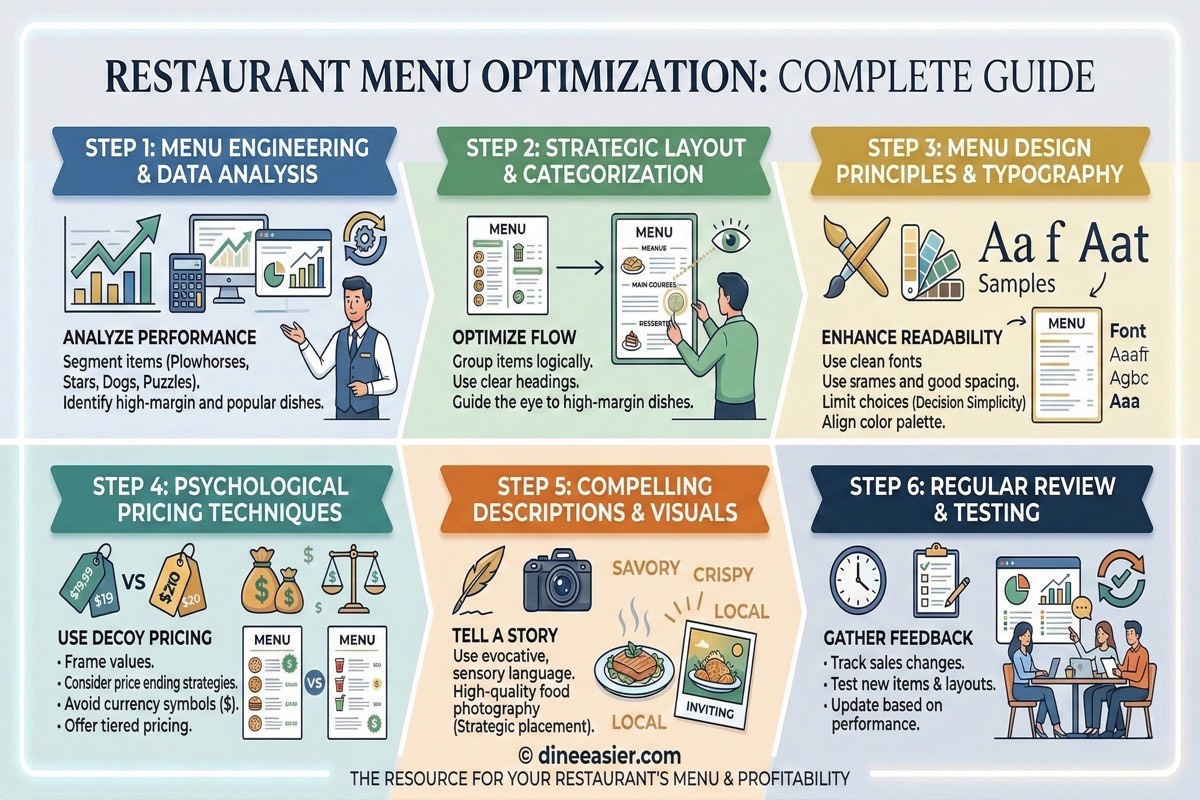
Why Dietary Tags on Your Menu Increase Restaurant Orders
Customers skip menu items they are unsure about. Dietary labels like veg, Jain, vegan, and allergen tags remove doubt, unlock group dining, and directly increase orders per table.